



CNEL Corruption, Your Electric Bill, and the Tenant Rights Nobody Told You About
If you've lived in Cuenca for more than a few months, you've probably had this conversation: someone mentions their electric bill seems off, someone else says the same, and everyone shrugs and says "that's just how it is here." Well — it turns out it wasn't just how it is. On April 28, 2026, the Ecuadorian government raided the offices of CNEL (Corporación Nacional de Electricidad) across multiple provinces, including CentroSur right here in Azuay, and uncovered a corruption network that had been rigging electric bills for over 11 years.
The scandal is massive. But for expats in Cuenca, it connects to something even more personal: a persistent myth about utility accounts that may have been costing you money for years.
The CNEL Corruption Network: What Happened
On the morning of April 28, 2026, President Daniel Noboa personally led a nationwide raid on CNEL offices, accompanied by Interior Minister Jhon Reimberg and Energy & Environment Minister Inés Manzano. The Secretary General of Public Integrity, José Julio Neira, was also present, along with military and police authorities.
What they found was a systematized fraud scheme that had been operating since approximately 2015 — more than 11 years.
How the Scheme Worked
The corruption network operated through two main mechanisms:
Path 1 — Direct Manipulation: A real meter reading would be taken and entered into CNEL's SAP commercial system. Then, without any customer filing a complaint, corrupt officials would go back into the system, lower the consumption reading, and re-issue the bill — sometimes with values reduced by up to 80%. No justification, no technical review, no oversight. The "cleaned" bill was handed to the bribing customer, and the honest ones across Ecuador subsidized the difference.
Path 2 — The ARCONEL Pipeline: When a customer did file a complaint and CNEL denied it, the case would escalate to ARCONEL (the electricity regulatory agency). From inside ARCONEL, corrupt officials would issue resolutions that allowed the bill to be re-issued — or the debt eliminated entirely. This was the second, more sophisticated route: regulatory capture at the agency that was supposed to be the watchdog.
The Numbers
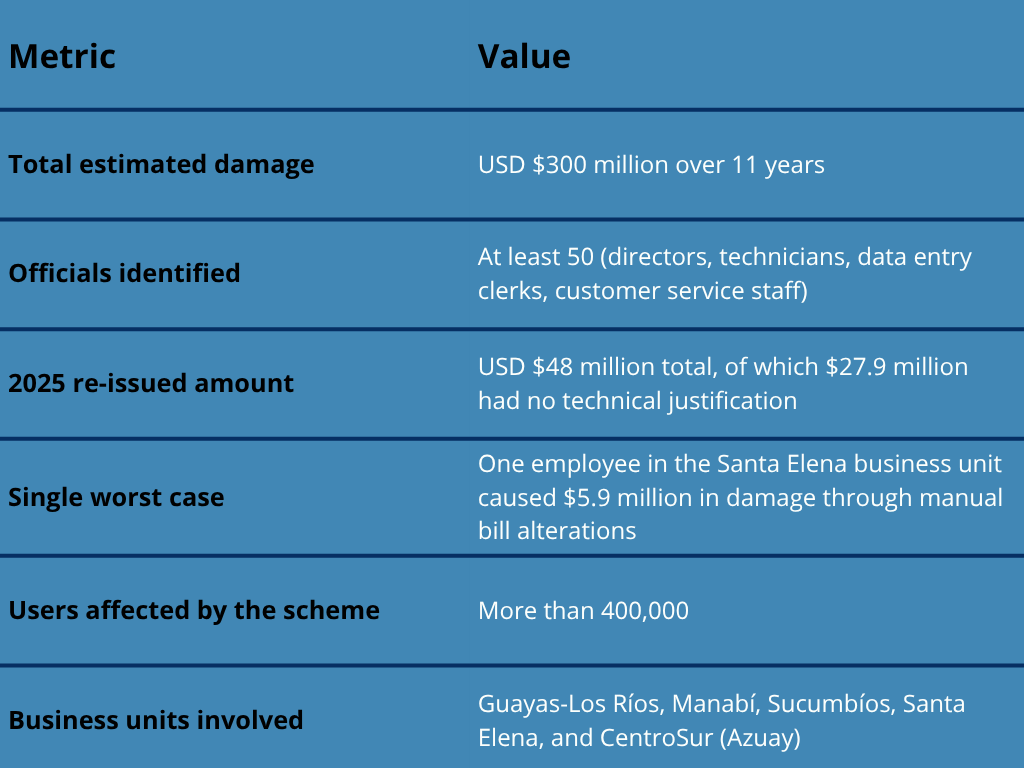
Yes — CentroSur, the electric company serving Cuenca and all of Azuay, was among the offices raided.
What Happens Next
The Contraloría General del Estado (Comptroller's Office) and the Fiscalía General del Estado (Attorney General's Office) are now leading the criminal investigation. CNEL's authorities were replaced immediately, and the government intervened in the company's IT systems to preserve digital evidence. Every modification in the SAP system leaves a trace with a user code — meaning investigators can track exactly who changed what, and when.
Why Expats Always Suspected Something Was Off
If you're an expat in Cuenca, the CNEL scandal probably doesn't surprise you. Inconsistencies and overcharges on electric bills have been a perennial topic in expat conversations — at dinner parties, in WhatsApp groups, on Facebook forums. Bills that seemed inexplicably high one month and oddly low the next. Meter readings that didn't match the charges. A general sense that the system was opaque and nobody could really explain how the numbers were calculated.
Now we know: at least some of those inconsistencies weren't bugs. They were features — of a system designed to benefit some at the expense of everyone else.
But while the CNEL corruption network was defrauding the country at scale, there's a separate issue that hits expat tenants directly — one that has nothing to do with corruption and everything to do with misinformation.
The Utility Account Myth That's Costing You Money
Here's a scenario many Cuenca expats will recognize: you rent an apartment or house, and when you ask about putting the electric or water bill in your name, your landlord — or your real estate agent — flatly refuses. "The meter has to stay in the owner's name," they say. "It's the law." "You can't change it." Sometimes they say it very firmly, as though it's not up for discussion.
It is not true.
Both Empresa Eléctrica CentroSur and ETAPA (Cuenca's water utility) allow the name on the invoice to be changed so that a tenant is listed as the person responsible for paying — while the meter itself remains under the property owner's name. This is a documented, established process at both companies.
Why It Matters: The 50% Senior Discount
If you are 65 or older and living in Ecuador, you are entitled by law to a 50% discount on public services — electricity and water included. This discount is tied to the person consuming the service, not to the property owner. An owner who is over 65 but not living in the building does not qualify. A tenant who is over 65 and consuming the service does.
As community member Renee Ecuador explained it clearly: "The discount issue is 100% not connected to who owns the property or the meter. It's a benefit that's given to a person who is a consumer of the public services of water and electricity who is a senior. Whether they are a tenant or an owner is irrelevant — if they are living in the house and getting the services and they're over 65, they're entitled to it."
If your utility account is only in the landlord's name and you're over 65, you are likely not receiving the discount you're legally owed. That's real money — month after month, year after year.
Why Landlords Resist (and Why Their Reasons Don't Hold Up)
Community member Patricia Olivo, who has successfully helped tenants complete this process twice, identified three reasons landlords typically resist:
1. "It's too much paperwork" / Notary fees
A notarized rental contract is required for the name change. Some landlords don't want to pay the notary fees, or they simply don't want to deal with the administrative process. This is about convenience, not legality.
2. Outstanding debts with the utility companies
To change the payer name on an account, the account must have no outstanding debts. Some landlords have unpaid balances — sometimes significant ones — and they don't want that to surface. This is understandable, but it's the landlord's debt to resolve, not a reason to deny a tenant their legal rights.
3. They simply don't understand the process
Many landlords — and many real estate agents — genuinely believe the myth that the account can only be in the owner's name. They heard it from someone, who heard it from someone else. They've never checked with the utility company themselves. And when presented with evidence to the contrary (as Renee Ecuador noted after sharing screenshots of her conversations with CentroSur directly), some still argue against it.
Patricia Olivo put it bluntly in a Facebook post discussion: "I think this chat is useless when people commenting don't actually know the laws. [...] I have done these changes twice recently, and they worked perfectly. [Renee] even showed you the chats with Empresa Eléctrica, yet you still argue about it."
What the Landlord Doesn't Lose
The property owner retains full control. The meter stays registered to the property. The owner can change the account back to their name at any time — without the tenant needing to be present. There is no risk, no loss of ownership, and no jeopardy to the owner's rights. The only thing that changes is who receives the bill and who pays it.
How to Change the Payer Name: The Actual Process
Based on requirements confirmed by CentroSur customer service agents, here is what you need to change the name on your electric bill as a tenant:
For CentroSur (Electricity)
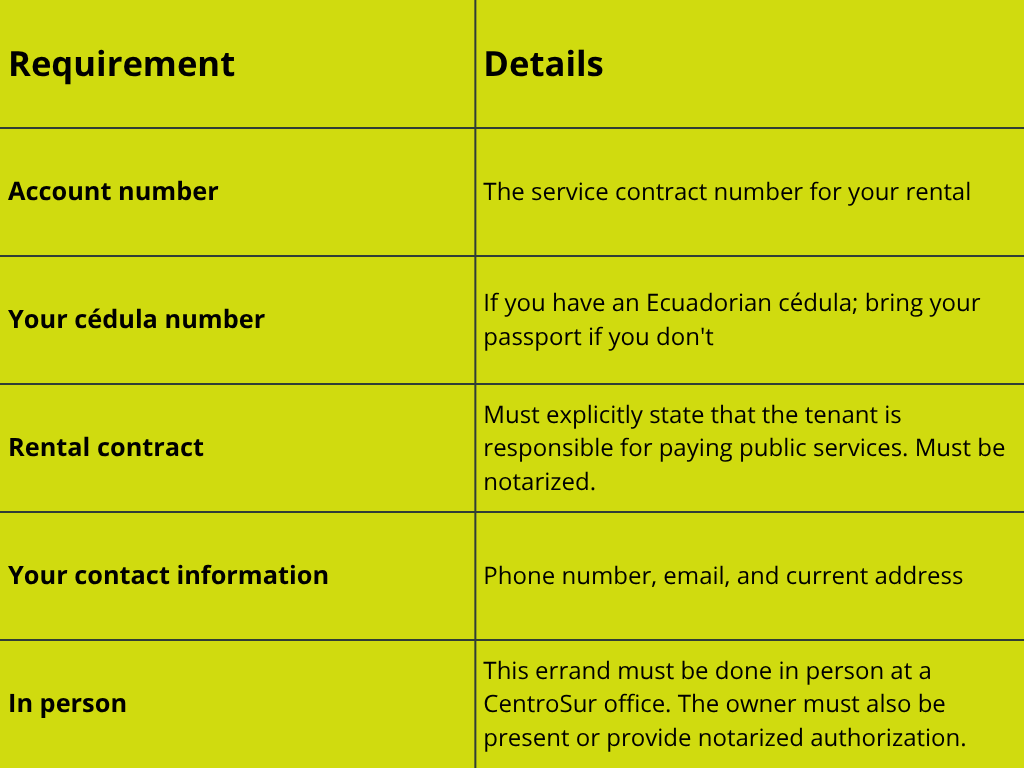
For CentroSur (Electricity)
ETAPA has a dedicated page for senior and disability discounts at etapa.net.ec/descuentos-de-tercera-edad-y-discapacidad/. The process is similar: you need your rental contract, identification, and the account number. ETAPA's customer service center (contact center: 188) can provide the exact current requirements, and they have offices in Centro, Gapal, and Mall del Río.
Important: Both processes require the participation of the property owner. This is the key step — and the one that often fails because the owner simply doesn't want to spend a day running the errand. If your landlord refuses, you have a legitimate reason to push back. This is your legal right as a tenant and as a senior resident.
Key Takeaways
The CNEL corruption was real and systemic. At least 50 officials manipulated electric bills across Ecuador for 11+ years, causing an estimated $300 million in damage. CentroSur in Azuay was among the offices raided. If your bills ever seemed inexplicably inconsistent, you weren't imagining it.
You can have the utility bill in your name as a tenant. Both CentroSur and ETAPA allow it. The meter stays in the owner's name — only the payer name on the invoice changes. The owner retains full control and can revert the change at any time without your presence.
If you're 65+, you're entitled to a 50% discount on electricity and water. This is a personal benefit tied to the consumer, not the property owner. If your account is only in the landlord's name, you may be paying full price unnecessarily.
Landlord resistance is common but not legally grounded. The three main reasons — notary fees, outstanding debts, and simple ignorance of the process — are obstacles, not legal barriers. A real estate agent who tells you "it can't be done" is either misinformed or unwilling to do the work.
The process requires the owner's participation. You cannot change the payer name unilaterally. The owner must accompany you (or provide notarized authorization) and the account must be debt-free. Budget 1-2 days for the errands.

Javier V.
10-year immigrant in Cuenca, Ecuador
Member of multiple local business circles and communities, including many English-speaking expat groups
Enfoquec — "La empresa eléctrica CentroSur en Azuay también fue allanada" (April 28, 2026)
Nuevo Tiempo Cuenca — Facebook post on CNEL raid (April 28, 2026)
Distrito Minero TV — Facebook post on CNEL corruption network details (April 28, 2026)
Presidente Daniel Noboa — Official announcement on CNEL disarticulation (social media, April 28, 2026)
ETAPA EP — Descuentos de tercera edad y discapacidad (etapa.net.ec)
Community members: Renee Ecuador, Patricia Olivo, Maria Pia Martin — HUBiteers group discussions on utility account name changes
Unlock More Essential Expat Insights
Don't navigate the exciting, yet often complex, world of expat life in Cuenca alone. Our newsletter is your direct line to even more powerful insights on the specific pain points we've discussed, offering practical solutions and strategies gleaned from years of on-the-ground experience.
Beyond advice, we'll also share trusted recommendations for service providers – from reliable facilitators and legal experts to property managers and community groups – who consistently go the extra mile to support expats like you. Think of it as your curated list of allies dedicated to your successful transition and long-term happiness in Ecuador.
Ready for More?
Subscribe to our newsletter today and empower your Cuenca experience with the knowledge and connections you need to thrive.



NEWSLETTER
Stay updated with the best Cuenca information!