



The Ecuador Professional Visa: Your Pathway to Remote Work Paradise (When Retirement Visa Isn't an Option)
So you've been dreaming of Ecuador. Maybe you've watched the YouTube videos, scrolled through the expat Facebook groups, and calculated your budget against Cuenca's cost of living. But there's a problem: you don't quite meet the $1,627/month income requirement for the Pensioner Visa.
Good news: Ecuador has another option that's become the most popular visa pathway for Americans, Canadians, and Europeans under 65. The Professional Visa requires just $482/month in provable income — less than a third of what the retirement visa demands.
Here's what you need to know, including the honest truth about working in Ecuador as an expat.
What Is the Professional Visa?
The Professional Visa is Ecuador's residency pathway for foreign nationals with a university degree. Despite the name, you don't need to work in Ecuador. Remote workers, digital nomads, freelancers, early retirees with a degree, and anyone with foreign income qualifies.
You can work for clients or employers anywhere in the world while living legally in Ecuador.
This makes it perfect for:
Remote employees of U.S., Canadian, or European companies
Freelancers with international clients
Digital nomads with location-independent income
Early retirees who have a degree but don't meet pension income thresholds
Entrepreneurs running businesses outside Ecuador
The Requirements (Simpler Than You Think)
You need four things:
A university degree that can be registered with SENESCYT (Ecuador's higher education authority)
Provable monthly income of at least $482 from foreign sources
A clean criminal background check from your home country
A valid passport with at least six months remaining
The degree registration is the step most people underestimate. It takes 30–90 days and requires specific documents from your university. Let's break this down.
SENESCYT: The Critical First Step
Before you can apply for the Professional Visa, Ecuador requires your university degree to be registered with SENESCYT — the Secretaría Nacional de Educación Superior, Ciencia, Tecnología e Innovación. This is the step that derails most DIY applicants.
SENESCYT needs:
Your original diploma (apostilled)
Official transcripts
A specific letter from your university describing how your degree was earned
The process officially takes 30 business days but frequently stretches to 60–90 depending on when you submit and how busy they are. Submit during June–August and you'll hit their peak backlog.
Can you use an online degree? Yes — SENESCYT accepts degrees from accredited online universities, including competency-based programs like WGU. The key is accreditation and proper documentation.
What if SENESCYT rejects my degree? Minor rejections (formatting, missing signature) are common. Most can be corrected through a subsanación (correction) process. This is where having someone who knows the system saves you months.
The Honest Timeline
Most websites say "4–6 months." Here's the realistic breakdown:
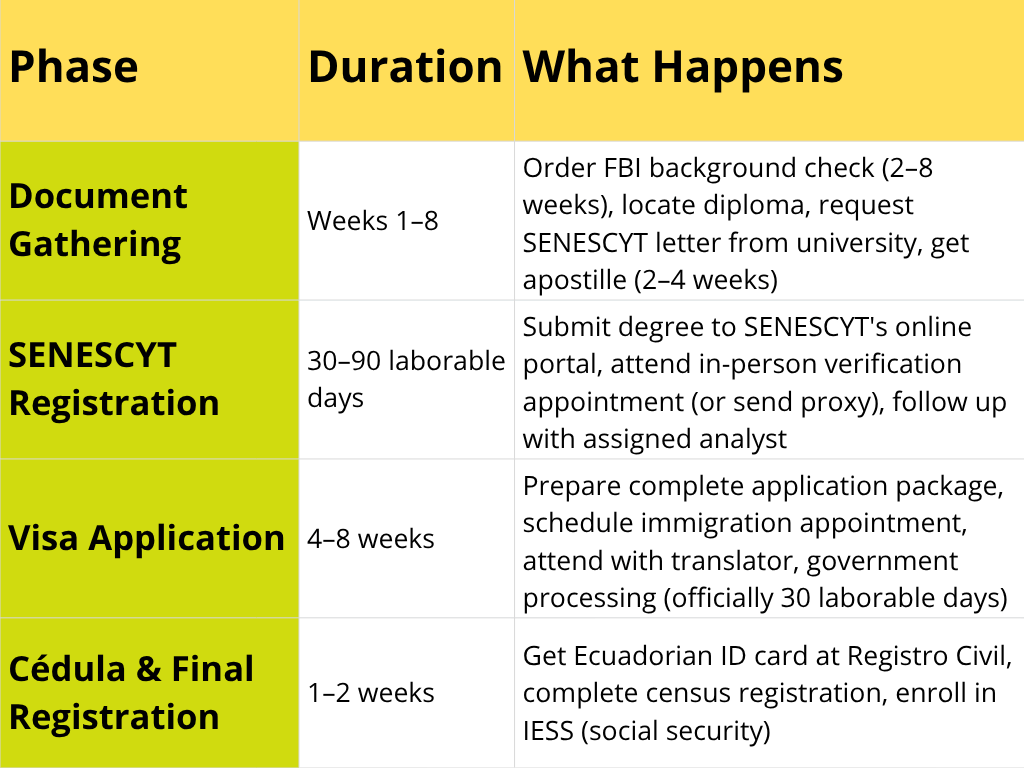
Realistic total: 5–8 months from "I've decided" to "I'm holding my cédula."
Some clients finish in 4–6 months because they start SENESCYT immediately and run document gathering in parallel.
What It Costs
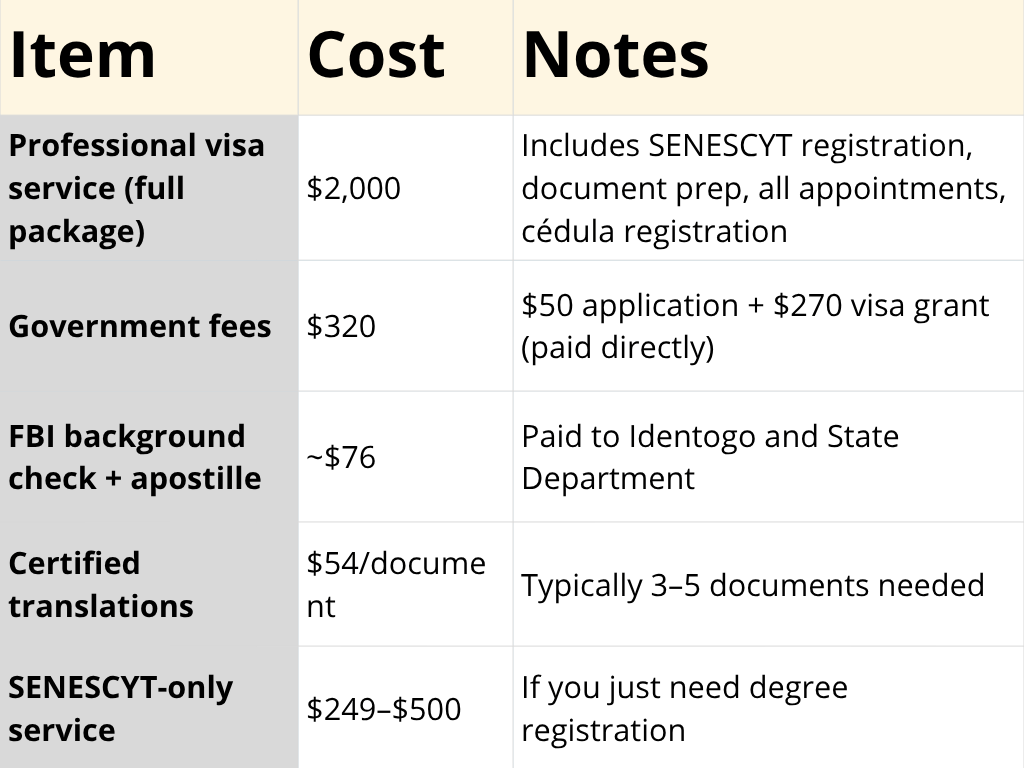
Total out-of-pocket: Approximately $2,400–$2,600 if you hire full-service help, or under $500 if you DIY everything yourself (plus your time and potential headaches).
Should Expats Work in Ecuador? The Honest Answer
Here's where things get complicated. The Professional Visa allows you to work in Ecuador, but should you?
The short answer: It depends, but most of the time, no.
The Reality of Local Employment
Let's talk numbers. Ecuador's minimum wage in 2026 is $482/month. That's barely below the Professional Visa's income requirement — and it's what many entry-level positions pay.
According to Ecuador's economic data:
Average monthly salary in formal employment: $500–$800
Professional roles (marketing, administration, teaching): $600–$1,200
Hospitality and tourism: $400–$700 base + tips
Senior management (rare for foreigners): $1,500–$3,000
The problem isn't just the pay. It's the trajectory. Many expats report:
Waiting 2–3 years for a modest raise (10–15%)
Business owners not viewing foreigners as "key players" in long-term growth
Limited upward mobility unless you're in a niche skill
Benefits that don't match what you'd get remotely (IESS is decent but not comprehensive)
When Local Work Makes Sense
There are exceptions. Working in Ecuador can work if you're in:
Hospitality and Tourism
Hotels, tour operators, adventure tourism companies
Varied schedule options (high season vs. low season)
More stability as long as tourism flows
Opportunity for tips (especially in upscale establishments)
Speaking another language (English, German, French) is a powerful skill that commands premium pay
International Schools
Bilingual schools in Quito, Cuenca, Guayaquil
Pay ranges from $1,200–$2,500/month
Benefits often include housing allowance and flights home
NGOs and Development Organizations
Pay in USD or higher local rates
Mission-driven work with international teams
Specialized Skills Shortage
IT, specialized engineering, certain medical fields
Usually requires Spanish fluency and local licensing
The Remote Work Advantage
Here's why remote work is almost always the better play:
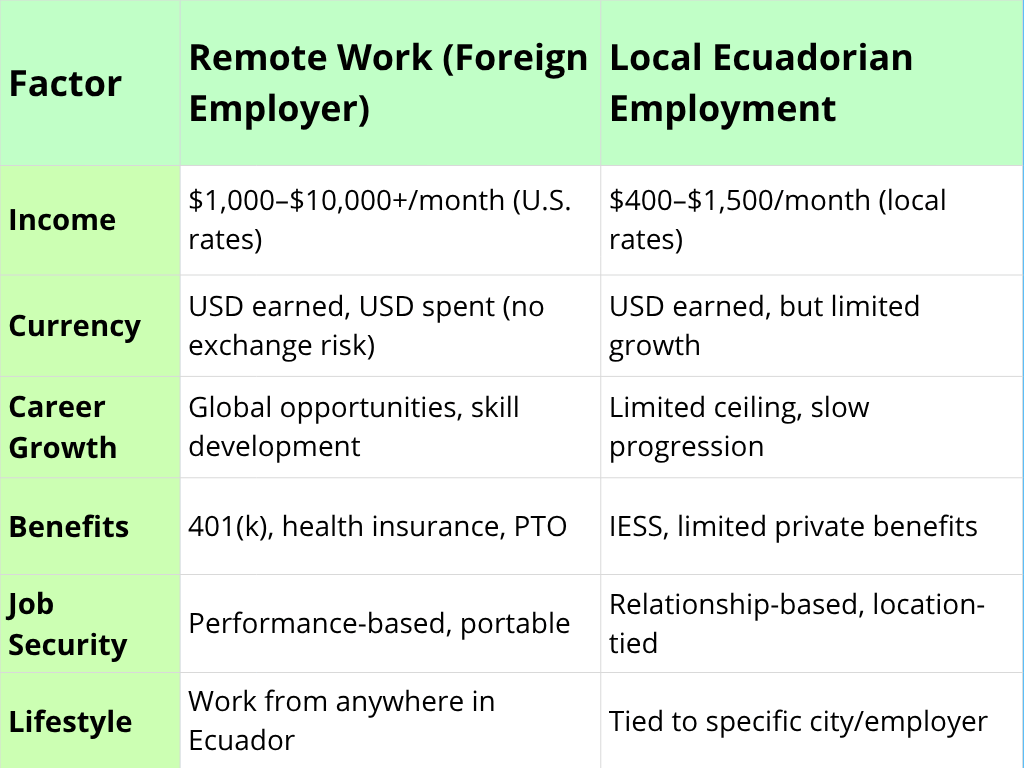
The math is simple: A remote job paying $1,500/month gives you 3x the purchasing power of a local job paying $500/month. In Ecuador's cost of living structure, that's the difference between "getting by" and "living well."
The Hybrid Strategy: Best of Both Worlds
Some expats adopt a hybrid approach:
Primary income: Remote work for foreign clients/employers ($1,000–$5,000/month)
Side income: Local hospitality/tourism work during high season ($400–$800/month + tips)
Benefits: Social connections, language practice, community integration, extra spending money
This strategy works particularly well for:
Digital nomads who want local connections
Semi-retired professionals who miss social interaction
Expats testing whether they like Ecuador before fully committing
Those building a portfolio career (consulting + teaching + tourism)
One More Option: Expert Witness and Appraisal Services
Here's an interesting niche that combines local income generation with serious earning potential: expert witness, appraiser, and court-appointed assessor services.
Why is this worth mentioning?
For reasons that aren't entirely clear, these services are exceptionally well-paid by Ecuadorian standards. Court-appointed expert witnesses (peritos judiciales) and regulated appraisers command fees that seem high in the local context:
Property appraisals for legal proceedings: $300–$800 per assignment
Expert witness testimony in civil cases: $100–$1,500+ per case
Technical assessments (engineering, medical, financial): $400–$1,500 per report
The catch? These roles are regulated and typically require:
Professional licensing in Ecuador (for the already listed fields of expertise, but if you bring in any new ones, guess what? You're able to justify legally not being licensed* but having the right field of experience to be an expert witness)
Spanish fluency (legal terminology)
Local professional network
Sometimes, Ecuadorian citizenship or permanent residency (only related to the specific demands of the project)
Why does this pay well? The market is small, qualified bilingual professionals are rare, and the legal system requires certified experts. Supply and demand, basically.
I'll be writing another article detailing this pathway — how to get licensed, what the requirements are, and whether it's worth the effort for your situation. If you're a professional (engineer, accountant, medical professional, real estate expert) considering Ecuador, this could be a fascinating income stream to layer on top of remote work.
The Bottom Line
The Professional Visa is Ecuador's most accessible residency pathway if you have a university degree. At $482/month income requirement, it's within reach for remote workers, freelancers, and early retirees who don't meet the Pensioner Visa threshold.
The strategy that works:
Start SENESCYT registration immediately (even before you're 100% committed)
Maintain or secure remote income from foreign sources
Plan for a 5–8 month timeline
Budget $2,400–$2,600 for full-service help, or under $500 for DIY
Don't count on local employment as your primary income (unless you're in tourism/hospitality as a side gig)
Consider niche opportunities like expert witness work as a bonus income stream
Ecuador isn't going to make you rich through local employment. But with remote income, it offers an incredible quality of life at a fraction of what you'd spend in the U.S., Canada, or Europe.
The Professional Visa is your ticket to that life. Just go in with realistic expectations about work, and you'll be fine.
Unlock More Essential Expat Insights
Don't navigate the exciting, yet often complex, world of expat life in Cuenca alone. Our newsletter is your direct line to even more powerful insights on the specific pain points we've discussed, offering practical solutions and strategies gleaned from years of on-the-ground experience.
Beyond advice, we'll also share trusted recommendations for service providers – from reliable facilitators and legal experts to property managers and community groups – who consistently go the extra mile to support expats like you. Think of it as your curated list of allies dedicated to your successful transition and long-term happiness in Ecuador.
Ready for More?
Subscribe to our newsletter today and empower your Cuenca experience with the knowledge and connections you need to thrive.



NEWSLETTER
Stay updated with the best Cuenca information!