



Ecuador's Silent Killer: Why Floods Are the Greatest Threat to Your Cuenca Life
⚠️ The Reality Nobody Talks About
When you think of natural disasters in Ecuador, what comes to mind?
Earthquakes? Volcanic eruptions?
Here's what should actually keep you up at night: floods.
South America's biggest tragedies don't come from dramatic explosions or sudden tremors. They come from water. Slow, relentless, devastating water that washes away roads, collapses bridges, cuts off entire communities, and reveals the hidden weaknesses in infrastructure that looked just fine during dry season.
The numbers don't lie:
2026 rainy season (January-March): 40,000+ people affected, 8 deaths, 1,332 rain-related incidents across Ecuador
2022 floods: 32 deaths, 550 families displaced in Quito alone, described as "Ecuador's worst flood"
April 3, 1950: Cuenca's worst flood on record—15 bridges destroyed, entire neighborhoods underwater, unknown number of people disappeared into the Tomebamba River
This is the reality of living in the Andes. And if you're planning to make Cuenca home, you need to understand it—not fear it, but respect it.
🌧️ The Two Faces of Cuenca's Rainy Season
Cuenca has a temperament. Most of the time, it's gentle. The rivers flow peacefully through the city. The afternoon rains are predictable, almost comforting.
Then there are times the rain appears to want to wash up something really stuck in the mountains that needs to come down, violently, with the weight of the water.
The 1950 Flood: When the Great Bridge Was Torn
On April 3, 1950, Cuenca learned what happens when the Tomebamba River wakes up.
Local newspapers called it "the biggest flood" in the city's history. A massive wall of water came down the Tomebamba on a Wednesday night, and by morning:
15 bridges destroyed (including the historic Puente de El Vado linking El Centro to the lower city)
Highways washed away, cutting off food relief convoys
Drinking water supplies severed
Entire neighborhoods underwater (San Roque, El Vergel, the corridor along Avenida 3 de Noviembre and 12 de Abril)
Water reached 1.5 meters high in some sectors
A newspaper article from April 7, 1950 reported:
"An unknown number of persons disappeared in the flood waters of the Tomebamba River when it swept through the town of Cuenca on Wednesday night. Five more bridges collapsed yesterday, bringing the total destroyed to 15. People crowded churches praying for relief."
The biggest and oldest bridge that had been inaugurated in Cuenca at that moment had its South side collapse. Today, you can still see the remnants. The Puente Roto (Broken Bridge) over the Tomebamba is now a tourist destination and cultural meeting point. It's a beautiful, haunting reminder of what happens when nature reminds us who's really in charge.
🌧️ Let's Look at What the Damage Can Be?
It's a reality that the tropical rainstorms end up being the biggest contributor to displaced families and temporary logistical nightmares.
As of March 13, 2026:
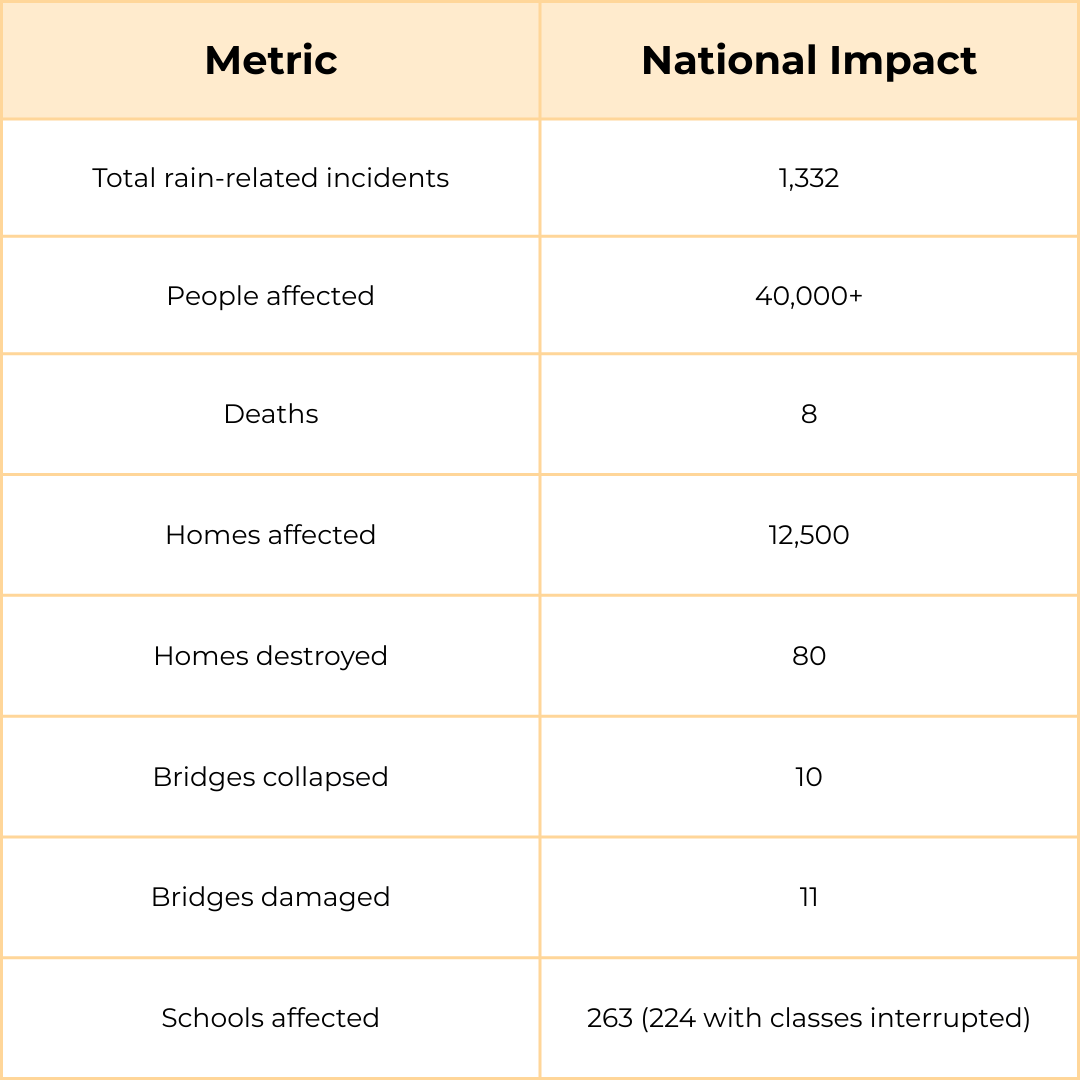
Source: ReliefWeb, The Cuenca Dispatch, MercoPress (March 2026 reports)
The 1950 Flood: When the Great Bridge Was Torn
Guayas, Manabí, Esmeraldas, Los Ríos, El Oro, Santa Elena, Loja, Chimborazo
Cuenca-Specific Impacts (February-March 2026)
15 neighborhoods flooded in Cuenca alone, including:
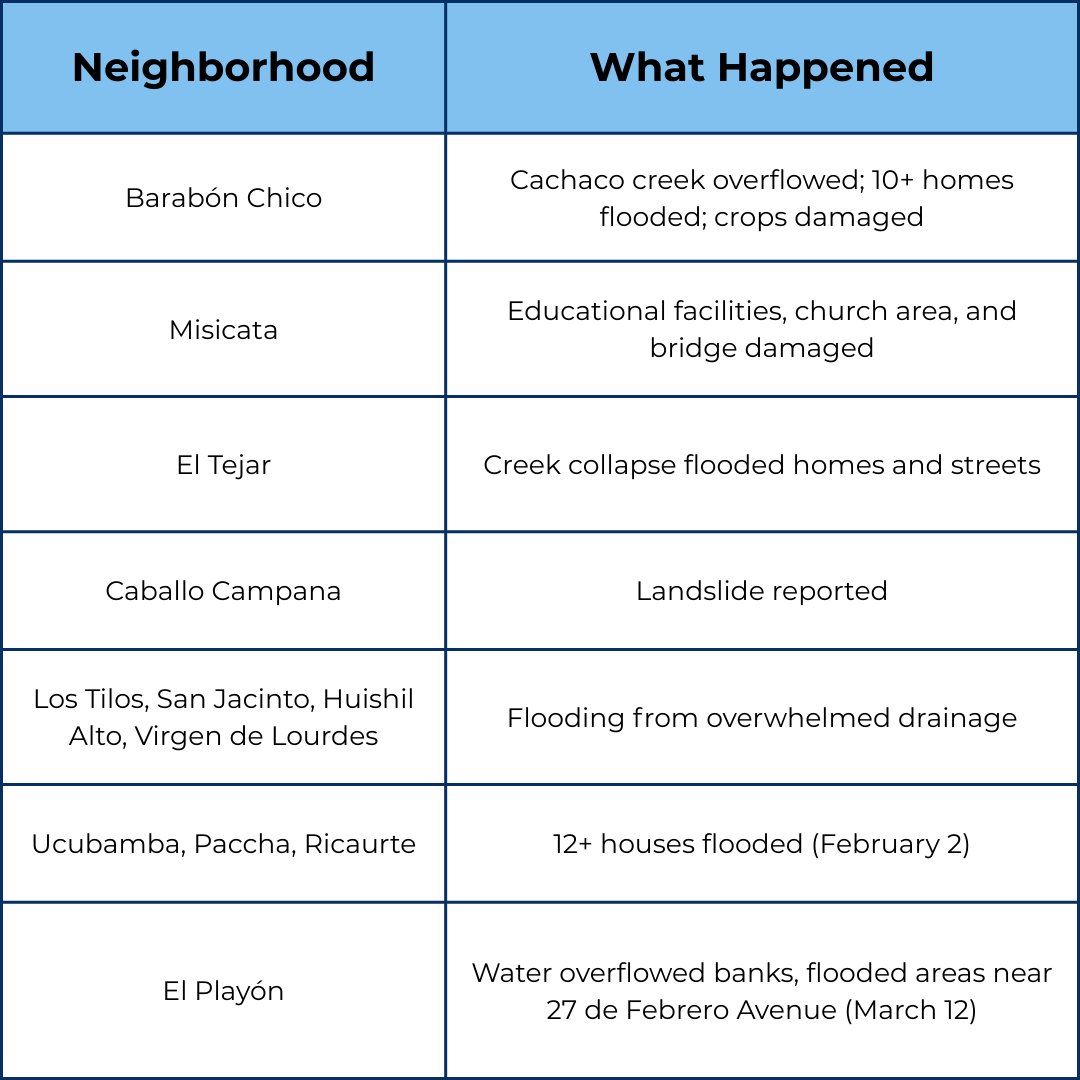
Four western neighborhoods are particularly vulnerable (they sit at the base of the mountains where rainfall is heaviest):
Baños
San Joaquín
Sayausí
Misicata
Source: Cuenca Expat, ECU 911, TikTok/YouTube incident reports
🛣️ The First Domino: Road Closures
Here's how it typically unfolds:
Day 1: Heavy rains begin. Nothing unusual.
Day 2: You hear about a landslide on the Cuenca-Girón road. No big deal—you're not going to El Oro anyway.
Day 3: Both major highways out of Cuenca are closed.
This isn't hypothetical. This happened on March 13, 2026.
Roads Closed (as of March 13, 2026)
Cuenca - Girón - Pasaje (to El Oro province):
Kilometer 42: Landslide
Kilometer 47: Culvert replacement (one lane open)
Kilometer 49: Road undermining (half lane open)
Kilometer 50: Major landslide (traffic closed)
Tunnel sector: Landslide (one lane open)
Cuenca – Molleturo – El Empalme (to Guayaquil):
Kilometer 91: Road undermining
Kilometer 98: Rock fragmentation (one lane open)
Kilometer 102: Major landslide (passage closed for debris removal)
Alternative routes required:
To Guayaquil: Cuenca → Cañar → La Troncal (adds 2-3 hours)
To El Oro: Zhud → Cochancay → Puerto Inca → Machala (adds 1-2 hours)
Source: El Mercurio, March 13, 2026
🏗️ Why This Keeps Happening: The Ridge Problem
Ecuador's geography is both its greatest beauty and its biggest vulnerability.
The problem: Many of the limited access roads in Ecuador need to pass through ridges (mountain passes). These ridges are:
Steep (prone to landslides when saturated)
Narrow (no alternative routes when one section fails)
Expensive to maintain (constant erosion, rock falls, drainage issues)
Critical connectors (often the ONLY road between two regions)
When heavy rains hit:
Soil becomes compromised
Ridges lose structural integrity
Landslides block the only road
Entire provinces get cut off
This is not a maintenance problem. This is a geography problem. And geography doesn't care about your delivery schedule. Although, sometimes lack of long-term planning can definitely cause problems or worsen those caused by nature.
🌉 The Bridge Collapse Cascade
When rivers swell during heavy rains, rural locations face a double vulnerability:
They're less prepared to deal with heavy rains (limited drainage infrastructure, fewer emergency resources)
Their bridges collapse (older construction, less engineering for extreme water flow)
2026 rainy season toll:
10 bridges collapsed
11 bridges damaged
Historical context: In the 1950 Cuenca flood alone, 15 bridges were destroyed in one night.
What this means for you:
A 30-minute drive can become a 3-hour detour
Emergency services can't reach you
Food and fuel supplies get interrupted
You're stuck wherever you are
💩 The Hidden Reality: Sewage Systems Exposed
Here's the uncomfortable truth:
You don't know how bad your city's sewage system is until the first major rain of the season.
During dry months, everything looks fine. The streets are clean. The drains work (mostly). Life is good.
Then the heavy rains come, and suddenly:
Streets turn into rivers (because drainage can't handle the volume)
Sewage mixes with floodwater (because the systems are connected or overflowing)
You discover which neighborhoods were built on old creek beds (because those are the first to flood)
You learn that "rapid urbanization" means "paved over all the natural drainage paths"
Cuenca's Drainage Problem
According to February 2026 reports:
The city's drainage infrastructure was built for a smaller population
Rapid urbanization in western areas has paved over natural drainage paths
Creeks like the Cachaco can overflow in minutes during intense rainfall
ETAPA's $58.4 million 2026 infrastructure plan includes drainage and sewer upgrades, but projects are still in procurement (as of February 2026)
Translation: The system is overwhelmed, upgrades are planned but not yet implemented, and you're living in the gap between problem and solution.
🚕 The Taxi Crisis Nobody Predicts
Here's a practical reality that doesn't make the news:
During heavy rains, getting a taxi in Cuenca becomes a major challenge.
Even when using an app, be prepared to wait at least 30 minutes for a taxi to actually accept your ride. Sometimes longer.
Why?
Drivers can't reach certain neighborhoods (flooded streets)
Demand spikes dramatically (everyone wants a taxi instead of walking)
Some drivers stop working (their own homes may be flooded, or they can't navigate safely)
Traffic slows everything down (what's normally a 10-minute trip becomes 40 minutes)
What this means for you:
That dinner reservation? You might be late.
That doctor's appointment? You might need to reschedule.
That flight to Quito? You might need to leave 2 hours earlier than planned.
Pro tip: If you see rain in the forecast and you have somewhere critical to be, book your taxi 30-60 minutes earlier than you normally would.
👟 The Most Important Thing You're Not Packing
Let's talk about footwear.
If you're moving to Cuenca and you're thinking about what to bring, here's what nobody tells you:
You need proper rainy season shoes.
Not "nice shoes that can handle a little water." Not "I'll just buy something here."
Proper. Rainy. Season. Shoes.
What Works:
Waterproof hiking boots (Gore-Tex or similar)
Rubber boots (for serious flooding—yes, you'll need these)
Waterproof walking shoes (for everyday use during rainy months)
Quick-dry materials (nothing that stays wet for days)
What Doesn't Work:
Canvas shoes (they'll be soaked in minutes)
Suede anything (ruined in one rainy day)
Cheap "water-resistant" shoes (they're not actually waterproof)
Open-toe sandals (unless you want to step in sewage-contaminated water)
Why this matters:
You'll be walking through flooded streets (sometimes ankle-deep)
Sidewalks become streams (drainage overflow)
Puddles hide potholes (ankle injuries are common)
Wet feet = cold feet (Cuenca is already cool; add rain and you're miserable)
Can you buy these in Cuenca? Yes, but:
Selection is limited
Quality varies significantly
Good waterproof boots are expensive (imported = markup)
Sizing may not match US/EU standards
Verdict: If you have specific footwear needs (wide feet, orthotics, specific brands), bring them from abroad.
Cuenca's Drainage Problem
Waterproof hiking boots (Gore-Tex or similar)
Rubber boots (for serious flooding—yes, you'll need these)
Waterproof walking shoes (for everyday use during rainy months)
Quick-dry materials (nothing that stays wet for days)
☂️ The Umbrella Situation
Speaking of rain gear, let's talk about umbrellas.
The reality: Umbrella designs and qualities in Cuenca are very limited.
What you'll find locally:
Small, compact umbrellas (fine for light drizzle)
Basic construction (not designed for strong winds)
Limited color/style options
Prices that don't match the quality
What you won't find easily
Large golf umbrellas (the kind that actually protect you)
Wind-resistant designs (double canopy, reinforced ribs)
High-quality materials (fiberglass ribs, premium fabric)
Sophisticated storage methods (travel cases, sleeves, stands)
Our recommendation: If you value staying dry, bring a top-quality umbrella from abroad.
What to look for:
Large canopy (58+ inches when open)
Wind-resistant design (vented canopy, fiberglass ribs)
Sturdy construction (reinforced joints, quality fabric)
Travel-friendly (if you'll carry it daily, weight matters)
Brands to consider: Blunt, EuroSCHIRM, Davek, Repel (all available in US/Europe, hard to find in Ecuador)
Is this essential? No. But after your third cheap umbrella turnss inside-out in a Cuenca windstorm, you'll wish you'd packed the good one.
🏠 The Rental Trap: Ground Level in Flood Zones
Here's the conversation you need to have before signing a lease:
"Has this neighborhood flooded during heavy rains?"
Not "Is this a nice neighborhood?"
Not "What's the internet speed?"
"Has this neighborhood flooded?"
High-Risk Neighborhoods in Cuenca
Based on February-March 2026 flooding data, these areas are particularly vulnerable:
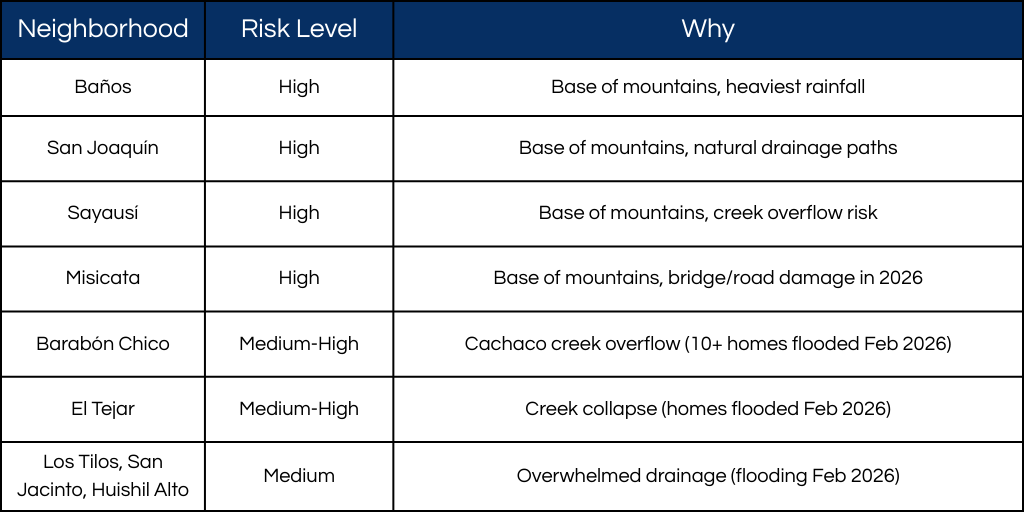
The ground level problem:
Even in neighborhoods that don't flood catastrophically, ground-level apartments face unique risks:
Water seepage through floors/walls
Sewage backup through drains
Insects/pests seeking higher ground (yes, this happens)
Mold/mildew from prolonged dampness
Difficulty selling/subletting after a flood event
Our advice:
Ask specifically about flooding history (landlords may not volunteer this)
Check the neighborhood's elevation (lower = more risk)
Look for water damage signs (stains on walls, musty smells, recent repainting)
Talk to neighbors (they'll tell you the truth)
Avoid ground level in high-risk neighborhoods (second floor or higher is safer)
Is ground level always bad? No. But in neighborhoods with known flooding issues, it's a risk you're taking.
💧 The Water Outage Reality
Here's another domino you might not expect:
Heavy rains → Infrastructure damage → Water service interruptions
March 13, 2026: Cuenca Water Outage
18+ sectors of Cuenca lost drinking water service
Suspension announced March 13 (reason not specified in available sources)
Part of broader infrastructure strain from rainy season
Why this happens:
Floods damage water treatment facilities
Sediment overwhelms filtration systems
Power outages affect pumping stations
Contamination risks require shutdowns for safety testing
What this means for you:
You could be without water for several days (not just hours)
You need to store water when you hear rain forecasts
You need backup plans for cooking, cleaning, and sanitation
Pro tip: Keep large containers (5-gallon jugs, buckets with lids) specifically for water storage. When heavy rains are forecast, fill them up before the outage happens.
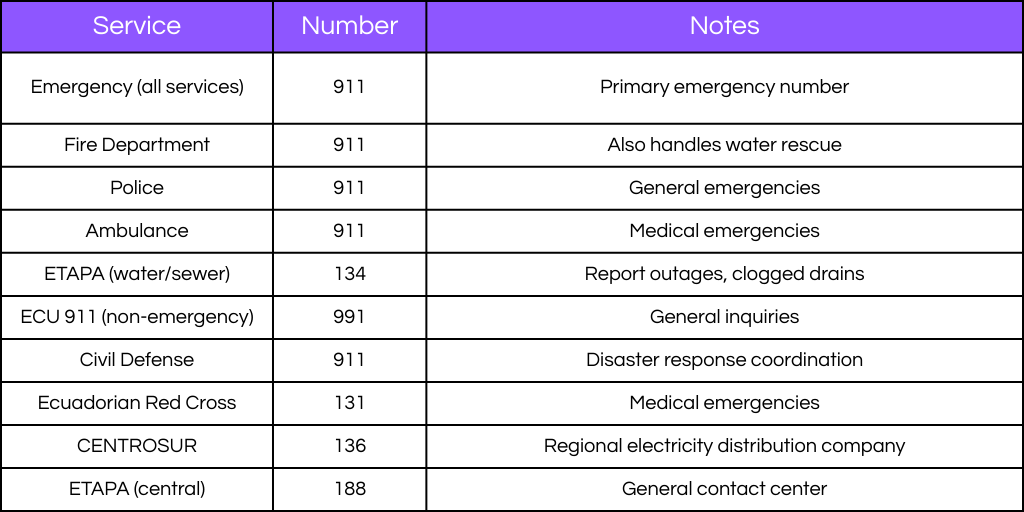
🚨 Emergency Contacts (Cuenca)
🌦️ The Bottom Line
Floods are Ecuador's—and much of South America's—greatest natural disaster threat. Not earthquakes. Not volcanoes. Water.
The pattern is predictable:
Heavy rains saturate the soil
Ridges collapse (blocking roads)
Rivers swell (collapsing bridges)
Drainage systems overflow (revealing hidden inadequacies)
Daily life grinds to a halt (taxis unavailable, water outages, schools closed)
This isn't fear-mongering. This is February-March 2026 reality.
But here's the good news:
You can prepare for this. You can live with this. You can even thrive during rainy season—if you respect it instead of being surprised by it.
Know your neighborhood's risk.
Have the right gear (shoes, umbrella, water storage).
Plan for delays (taxis, roads, appointments).
Stay informed (local news, emergency alerts).
And remember: The people who've lived here through multiple rainy seasons? They're not panicked. They're prepared. They have their boots by the door, their umbrella in the car, and their water jugs filled when the forecast looks bad.
That's the goal. Not fear. Preparation.
📚 Sources & Further Reading
Current Situation (2026)
ReliefWeb. "Ecuador: Floods - Jan 2026." https://reliefweb.int/disaster/fl-2026-000027-ecu
ReliefWeb. "Latin America & The Caribbean Weekly Situation Update as of 6 March 2026." https://reliefweb.int/report/ecuador/latin-america-caribbean-weekly-situation-update-6-march-2026
The Cuenca Dispatch. "Emergency declared as winter rains batter Ecuador, damaging homes, schools, and critical infrastructure." March 2, 2026. https://thecuencadispatch.com/emergency-declared-as-winter-rains-batter-ecuador-damaging-homes-schools-and-critical-infrastructure/
El Mercurio. "Status of the roads in Azuay this Friday, March 13. Two remain closed." March 13, 2026.
Cuenca Expat. "15 Neighborhoods Flooded and Lightning Strikes Hikers in Cajas." February 16, 2026. https://www.cuencaexpat.com/articles/carnival-storms-cuenca-flooding-lightning-cajas-february-2026
Historical Context
Becoming Cuenca. "A Historical Look at Cuenca." https://becomingcuenca.com/a-historical-look-at-cuenca/
Facebook Group "Ecuador Fotos Antiguas Colorizadas." "3 de Abril de 1950, la inundación del Tomebamba." April 4, 2024.
Wikipedia. "2022 Ecuador landslides." https://en.wikipedia.org/wiki/2022_Ecuador_landslides
Manila Standard. "Heavy S. America rains kill 24
in Brazil, 11 in Ecuador's worst flood." February 1, 2022.
Infrastructure & Planning
ETAPA EP. "2026 Infrastructure Plan." (Drainage and sewer upgrades mentioned in Cuenca Expat reporting)
Dirección Municipal de Gestión de Riesgos. Emergency response protocols.
💬 Have a rainy season story to share? Join the HUBiteers Community Group and tell us what you've learned. Your experience could help another veci prepare.
📍 Want to know which neighborhoods are safest? Check out our Interactive Cuenca Map and see risks in sectors. We will be studying the city to include flood risk zones and other key information about the city during strong weather.
Unlock More Essential Expat Insights
Don't navigate the exciting, yet often complex, world of expat life in Cuenca alone. Our newsletter is your direct line to even more powerful insights on the specific pain points we've discussed, offering practical solutions and strategies gleaned from years of on-the-ground experience.
Beyond advice, we'll also share trusted recommendations for service providers – from reliable facilitators and legal experts to property managers and community groups – who consistently go the extra mile to support expats like you. Think of it as your curated list of allies dedicated to your successful transition and long-term happiness in Ecuador.
Ready for More?
Subscribe to our newsletter today and empower your Cuenca experience with the knowledge and connections you need to thrive.



NEWSLETTER
Stay updated with the best Cuenca information!